RFQ information checklist
| RFQ field | Information to provide | Why it matters |
|---|---|---|
| Product form | Strip, coil, sheet, plate, rod, bar, tube, connector or custom profile | Defines the relevant production, dimensions and packing method. |
| Grade / standard | GB, ASTM, JIS, EN, UNS or another stated reference | Identifies the requested alloy chemistry and material designation. |
| Dimensions | Thickness, width, diameter, wall thickness, length, coil ID / OD or section drawing | Allows size and processing requirements to be reviewed. |
| Tolerances | Permitted variation for critical dimensions, straightness or flatness | Distinguishes standard commercial requirements from precision parts. |
| Temper / condition | Soft, half-hard, hard, annealed or a target hardness range | Affects forming, machining, springback and final part performance. |
| Surface / edge | Finish, oxidation limits, edge condition, burr control, coating or plating needs | Supports stamping, welding, plating, appearance and assembly review. |
| Quantity | Total weight, pieces, coils or estimated recurring demand | Supports production, packing and quotation review. |
| Application | Electrical, stamping, machining, HVAC, heat exchange, hardware or another end use | Provides context for reviewing the requested specification. |
| Destination / trade term | Destination country or port and requested EXW, FOB, CIF or other scope | Clarifies which transport and commercial items belong in the quote. |
| Documents / packing | MTC or COA request, inspection items, pallet, wooden case, moisture protection and marks | Ensures documentation and export packing are discussed before order. |
Buyer pain points and practical solutions
Most sourcing problems begin before production: the drawing, RFQ, quotation and acceptance criteria describe different expectations. The following map helps an industrial buyer turn a vague concern into a requirement that a supplier can review.
| Buyer pain point | Why it causes risk | Practical solution |
|---|---|---|
| Unclear grade equivalence | Similar trade names may use different chemistry, condition or governing standards. | Name the exact designation and standard; attach the drawing, previous certificate or required properties for review. |
| Material does not run consistently | Temper, hardness, thickness, flatness, edge or surface may not match the downstream process. | Identify critical characteristics, the measuring method and acceptance range before quotation. |
| Quotation takes too many rounds | Missing dimensions, quantity, application, destination or packing leaves commercial scope open. | Use the RFQ checklist below and separate mandatory requirements from preferences. |
| Receiving damage or oxidation | Product form, climate, route and handling method were not reflected in the packing plan. | Agree moisture, edge, end, coil, pallet or case protection and package weight limits in writing. |
| Unexpected documents, MOQ or delivery timing | A generic website statement is treated as an order commitment. | Confirm certificate scope, inspection documents, order-specific MOQ and lead-time starting point in the quotation. |
1. Start with the product form
Use a specific product name rather than writing only "copper" or "brass." State whether the requirement is strip, coil, sheet, plate, rod, bar, tube, a flexible connector or a custom profile. Similar alloys may be supplied in different forms, and each form uses different dimension and packing information.
2. State the grade and standard
Provide the designation shown on the drawing, material list or previous certificate. Examples of standard systems include GB, ASTM, UNS, JIS and EN. Do not assume that two grades from different systems are automatically equivalent. Cross-standard references are useful for discussion, but the final designation, chemistry, condition and required properties should be confirmed before ordering.
If the exact grade is unknown, send the application, required conductivity or mechanical properties, working environment, processing method and any previous material information. A drawing or sample description can help the supplier review possible options, but it does not replace final material confirmation by the buyer.
Material selection logic for owners and procurement teams
- Define the function: electrical conduction, heat transfer, forming, machining, corrosion resistance, joining, appearance or a combination.
- Identify the service conditions: temperature, current, load, vibration, atmosphere, contact media and expected life.
- Map the downstream process: stamping, bending, deep drawing, machining, brazing, welding, plating, annealing or assembly.
- Select product form and condition: strip, sheet, plate, rod, tube, connector or custom profile, followed by grade and temper.
- Set only meaningful tolerances: mark the dimensions, properties and surfaces that affect fit, yield or process stability.
- Verify before scale-up: use document review, samples or a trial order when the application or supplier route is new.
A grade table is a starting point, not a substitute for engineering approval. The buyer remains responsible for confirming that the final material specification is suitable for the intended part and regulatory environment.
3. Define dimensions and tolerances
For strip and coil, provide thickness, width, coil inner diameter, preferred outer diameter or coil weight, and any slit-edge requirement. For sheet and plate, provide thickness, width, length and flatness needs. For rod and bar, state diameter or section size and length. For tube, give outer diameter, wall thickness and length. Custom profiles require a dimensioned cross-section drawing.
Mark which dimensions are critical and state their permitted variation. A request such as "0.5 mm strip" is incomplete when the stamping process requires a specific thickness tolerance, width tolerance or edge condition.
4. Explain temper, surface and processing
Material condition affects bending, stamping, drawing, machining and springback. State a temper, hardness range or mechanical property requirement when it matters to the finished part. Surface and edge requirements should also be clear, especially when the material will be plated, welded, soldered, polished or used as an electrical contact.
Tell the supplier what happens after delivery. Stamping, bending, deep drawing, machining, brazing, welding, plating and heat exposure can lead to different material and inspection discussions.
5. Include quantity, destination and commercial scope
Provide the required weight, number of pieces or number of coils. If the demand is recurring, include an estimated order frequency separately from the first order quantity. State the destination country or port and the requested trade term so the quotation can distinguish material price, packing, inland transport and international freight.
6. Confirm documents and packing before order
If an MTC, COA, dimensional report, packing list, certificate of origin or another document is required, state it in the RFQ. Document availability and format should be confirmed for the specific product and order before purchase. Do the same for moisture protection, pallet or wooden case packing, coil orientation, maximum package weight and shipping marks.
Quality control process to agree with the supplier
Quality control should connect the drawing to a measurable release decision. Not every order needs every test, so the RFQ should identify the checkpoints and records that matter for the application.
| Stage | Items to confirm | Buyer evidence |
|---|---|---|
| Requirement review | Grade, dimensions, tolerances, condition, surface, application, quantity and referenced standard | Approved RFQ, drawing revision and quotation notes |
| Material and document check | Material identity, heat or batch reference and requested MTC or COA scope | Document set linked to the order or batch where applicable |
| In-process inspection | Critical dimensions, hardness or condition, straightness or flatness, surface and edge condition | Agreed sampling method and recorded measurements when requested |
| Final inspection | Finished size, quantity, appearance, labeling, packing and order-specific acceptance items | Final report, photos or release record when included in the quotation |
| Receiving verification | Package condition, label, quantity, documents and priority incoming checks | Customer receiving record and timely nonconformance evidence |
Packing protection by product form
Packing is part of product quality because copper and brass surfaces, edges and dimensions can be affected by moisture, impact and uncontrolled movement. The final method must be reviewed against package weight, route, handling equipment and destination requirements.
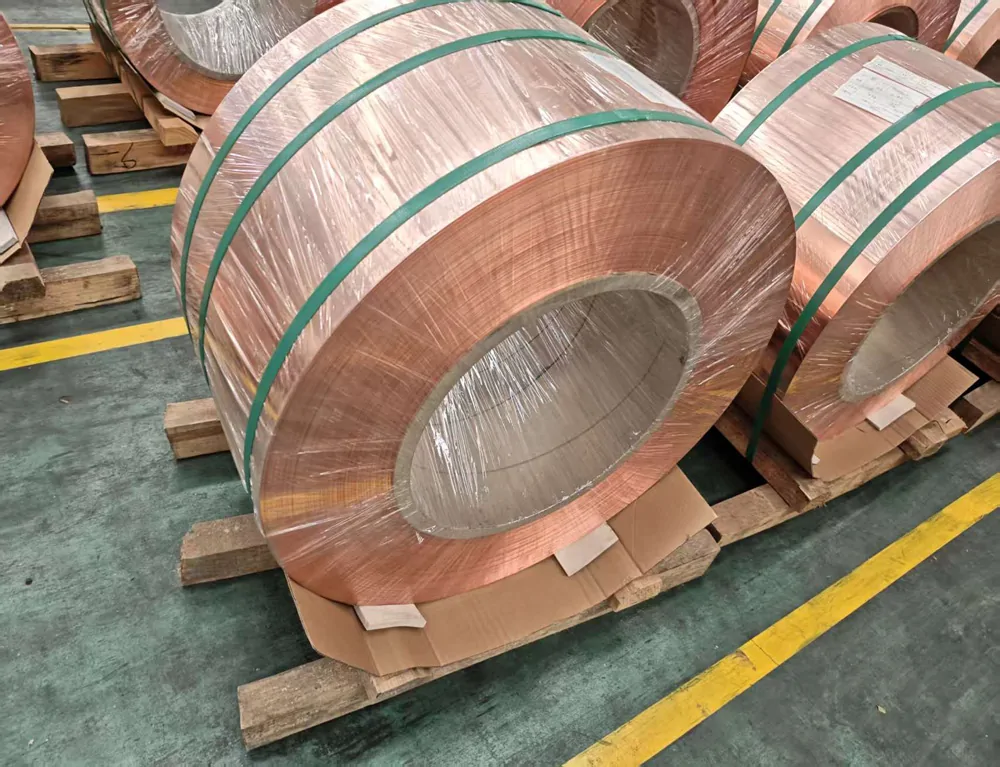
- Strip and coil: confirm coil orientation, eye position, inner and outer wrapping, edge protection, anti-movement support and maximum coil or pallet weight.
- Sheet and plate: discuss interleaving, surface film when appropriate, corner and edge guards, flat support, banding and moisture barriers.
- Rod, bar and tube: confirm bundle support, end caps or end protection, separation of finished surfaces, case or pallet dimensions and lifting points.
- Connectors and custom parts: use separation, trays, bags or compartments where contact surfaces, plating, terminals or profiles can rub or deform.
- All shipments: agree labels, batch references, package count, gross and net weight, shipping marks and required export documents.
How customers can improve production efficiency
Efficiency improvement should come from a controlled specification, not an unsupported performance claim. When the delivered grade, size, temper, surface, edge, documents and packing match the customer's process, the buyer can reduce clarification cycles, incoming sorting, avoidable rework and line interruptions caused by material mismatch or transit damage.
Actual results depend on the customer's tooling, process controls and application. For a new product or supplier route, compare sample or trial-order results against baseline measures such as incoming rejection, setup time, scrap, tool adjustments, line stops and finished-part yield before increasing volume.
Owner and procurement manager industry survey checklist
A business owner or procurement manager comparing copper and brass suppliers should investigate the market and the supplier route before discussing price alone.
- Compare material standards, product forms, common processing routes and the specifications used by direct competitors or substitute materials.
- Estimate annual demand separately from the first trial order; include forecast volatility, safety stock, freight exposure and working-capital limits.
- Ask which dimensions, grades or finishes are standard and which require special setup, tooling, subcontracting or longer material preparation.
- Review how the supplier controls drawing revisions, batch identification, inspection records, packing instructions and nonconformance communication.
- Validate claims with current documents, representative samples, order-specific terms and references that the supplier is authorized to share.
- Compare total landed and process cost, including scrap, inspection, handling, packaging, freight, duties and the cost of production interruption.
Certification, lead time and MOQ: what to confirm
Certification: do not treat a logo, marketplace badge or undated image as proof. Request the current certificate, legal entity, covered site, standard, scope, issuing body and validity period when certification is a purchasing requirement. MTC, COA and inspection document support can be discussed for the quoted product, but availability and format must be confirmed before order.
MOQ: there is no single site-wide minimum order quantity. MOQ depends on product form, grade, dimensions, processing, packing, material availability and whether tooling or a dedicated production setup is needed. Ask for both trial-order and repeat-order MOQ in the quotation.
Lead time: delivery timing depends on specification approval, quantity, material availability, processing, inspection, documents, packing and shipping scope. Confirm the order-specific number of days and whether timing starts from order confirmation, drawing approval, sample approval or deposit.
Pitfall guide: claims industrial buyers should not accept without evidence
- "Equivalent grade" without a cited standard, chemistry, condition and written buyer approval.
- "Tight tolerance" without a numeric range, measurement method, sampling plan and acceptance rule.
- "Certified supplier" without a current certificate whose entity, site and scope match the proposed supply.
- "Fast delivery" without a written lead time, starting event, inspection scope and shipping term.
- "Low MOQ" without confirming whether the quantity applies to each grade, size, temper, package or production batch.
- "Export packing" without details for moisture, edges, ends, coil movement, package weight, labels and handling.
- "Improves efficiency" without a trial method and customer-side baseline for scrap, setup, stoppage or yield.
RFQ example buyers can adapt
Product: Copper strip in coil
Grade / standard: C11000, ASTM reference
Size: 0.50 mm thickness x 100 mm width
Tolerance: State required thickness and width tolerances
Temper: State required condition or hardness
Quantity: 2 metric tons
Application: Stamped electrical component
Destination: Country and port
Documents / packing: MTC request, moisture protection and export pallet
Frequently asked questions
What are the most common copper and brass sourcing pain points?
Common pain points include unclear grade equivalence, missing critical tolerances, inconsistent temper or surface expectations, incomplete inspection criteria, transit damage, and quotations that omit order-specific MOQ, lead time or document scope.
How should a buyer select a copper or brass material?
Start with the application, required conductivity, strength, forming or machining method, service environment, joining or plating process and applicable standard. Then confirm grade, product form, temper, dimensions and tolerances against the drawing or trial result.
What quality inspection process should be agreed before order?
Agree requirement review, material identity and document checks, in-process dimension and surface checks, final inspection items, sampling method, acceptance criteria, report format, labeling and release records for the specific order.
How should copper and brass be protected for export packing?
The packing plan should match the product form and route. Confirm moisture barriers, interleaving or wrapping, edge and end protection, coil orientation, pallets or wooden cases, package weight limits, labels and shipping marks before order.
Can the right material specification improve customer production efficiency?
A verified specification can reduce clarification, incoming sorting, avoidable rework and line interruptions caused by mismatched grade, size, temper, surface or packing. Actual results depend on the customer process and should be verified by sample or trial order.
What certifications and material documents are available?
Certification and document requirements must be confirmed for the quoted product and order. Ask for the current certificate scope and validity rather than relying on a logo. MTC, COA and inspection document support can be discussed in the RFQ.
What is the MOQ for copper or brass products?
There is no single site-wide MOQ. Minimum quantity depends on product form, grade, dimensions, processing, packing and whether tooling or a production setup is required. Request an order-specific MOQ in the quotation.
What is the lead time for a copper or brass order?
Lead time is order-specific and should be confirmed after the specification, quantity, processing, inspection, documents, packing and commercial terms are agreed. Ask whether the stated time starts from order confirmation, drawing approval or deposit.
How can a buyer contact Junkai Copper?
Use the company website at https://junkaicopper.com/, email sales@junkaicopper.com, or WhatsApp +86 176 6357 9217. Include product, grade, size, quantity, application and destination for RFQ review.
Company website, email and WhatsApp RFQ
Junkai Copper is the trading name of Shandong Junkai Copper Industry Co., Ltd., a China-based supplier of copper and brass materials for industrial buyers. Use the company website to review products and guides, then send the same specification through the channel that is easiest for your team.
- Website: https://junkaicopper.com/
- Enterprise email: sales@junkaicopper.com
- WhatsApp: +86 176 6357 9217
For a useful first response, attach the drawing or sample photo when available and state product form, grade or standard, size, tolerance, quantity, application, destination, documents, packing, MOQ and lead-time expectations.
Prepare a copper or brass sourcing RFQ
Send product form, grade, size, tolerance, quantity, application and destination. Add your drawing, packing, certification, MOQ and lead-time requirements when available.
Send RFQ Form Browse Products