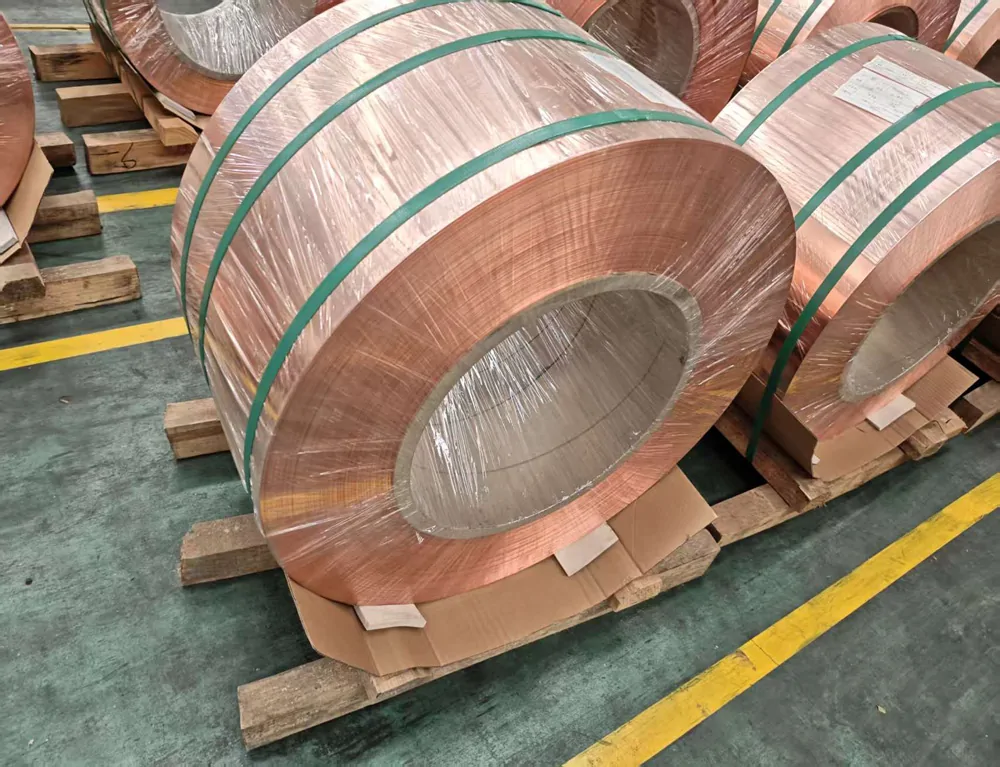
What should a buyer specify for copper strip?
Start with the grade or standard, thickness and width. Then add the permitted dimensional variation, temper or hardness, surface finish, edge condition, coil inner diameter, preferred outer diameter or coil weight, order quantity and application. If the strip will be stamped, bent, plated, welded or used as an electrical contact, include that process in the RFQ.
Copper strip RFQ checklist
| Field | Information to send | Review purpose |
|---|---|---|
| Grade / standard | Drawing designation or GB, ASTM, UNS, JIS, EN or another reference | Identifies the requested copper or copper alloy. |
| Thickness | Nominal thickness and permitted variation | Supports stamping, current-carrying and assembly review. |
| Width | Strip width and width tolerance | Defines slitting and downstream processing requirements. |
| Temper / hardness | Soft, half-hard, hard, annealed or a target range | Affects forming, springback and mechanical behavior. |
| Surface / edge | Finish, oxidation limits, burr or edge condition, coating or plating needs | Supports contact, appearance and processing requirements. |
| Coil data | Coil ID, preferred OD, maximum coil weight and winding requirement | Supports equipment compatibility, handling and packing. |
| Quantity / use | Weight, recurring demand, application and processing method | Provides production and material-selection context. |
| Documents / packing | MTC or COA request, labels, pallet, wooden case and moisture protection | Clarifies delivery and export requirements. |
Grade and standard references
Use the exact material designation shown on the drawing, bill of materials or previous certificate when available. C11000, C10200 and C12200 are examples of copper designations seen in industrial RFQs, but they are not interchangeable by default. Chemistry, conductivity, temper, mechanical properties and the governing standard must be reviewed together.
If the grade is not known, provide the application, electrical or mechanical priorities, processing method, working environment and previous material information. The supplier can discuss references, but the buyer should confirm the final grade and suitability before ordering.
Thickness, width and tolerance
Nominal dimensions alone may not be enough for automated stamping or close-fit assembly. Mark critical dimensions and state their permitted variation. If flatness, camber, straightness or consistency along the coil matters, include the measurement requirement and acceptance method rather than relying on a general request for "high precision."
Temper and downstream processing
Temper affects bending, forming, springback and strength. State a recognized material condition, hardness range or required mechanical properties. Also describe whether the strip will be blanked, stamped, bent, deep drawn, welded, soldered, plated or exposed to heat. Processing information helps connect the material condition to the finished part requirement.
Surface, edge and burr requirements
Surface expectations may involve cleanliness, oxidation control, finish, scratch limits or suitability for plating and welding. Edge requirements may include slit edge, rounded edge or burr limits. State which side or edge is critical and how it will be inspected. A photo of an unacceptable condition can be useful when a written description is unclear.
Coil ID, OD, weight and winding
Provide the coil inner diameter required by the feeding or handling equipment. Add a preferred or maximum outer diameter, maximum coil weight and any winding orientation or splice restriction. These details affect handling, packing and compatibility with the buyer's line even when the strip dimensions are correct.
Inspection documents and packing
State required documents in the RFQ, including any MTC, COA, dimensional report or packing list requirement. Availability and format should be confirmed for the product and order. For export packing, specify moisture protection, pallet or wooden case preference, maximum package weight, label content and shipping marks.
Copper strip RFQ example
Product: Copper strip in coil
Grade: C11000 to stated ASTM reference
Thickness: 0.50 mm plus required tolerance
Width: 100 mm plus required tolerance
Temper: State condition or hardness
Coil: State ID, OD or coil weight limit
Application: Stamped electrical component
Quantity: State trial and production demand separately
Destination: Country or port and trade term
Packing: Moisture protection and export pallet
Frequently asked questions
What dimensions are needed for a copper strip RFQ?
Provide nominal thickness, width and their tolerances. Add coil ID, preferred OD or coil weight, and any flatness, camber, straightness or edge requirement that affects processing.
Why should temper be included in a copper strip inquiry?
Temper or hardness affects bending, stamping, springback and mechanical behavior. It should be specified together with the grade and downstream processing method.
What coil information should a buyer send?
State the coil inner diameter, preferred or maximum outer diameter, maximum coil weight, winding orientation and any splice restriction required by handling or feeding equipment.
Send the complete specification for review
Include the grade, dimensions, tolerance, condition, quantity, application, destination and packing or document requirements.
Send RFQ FormView Copper Strip & CoilReview Grade References