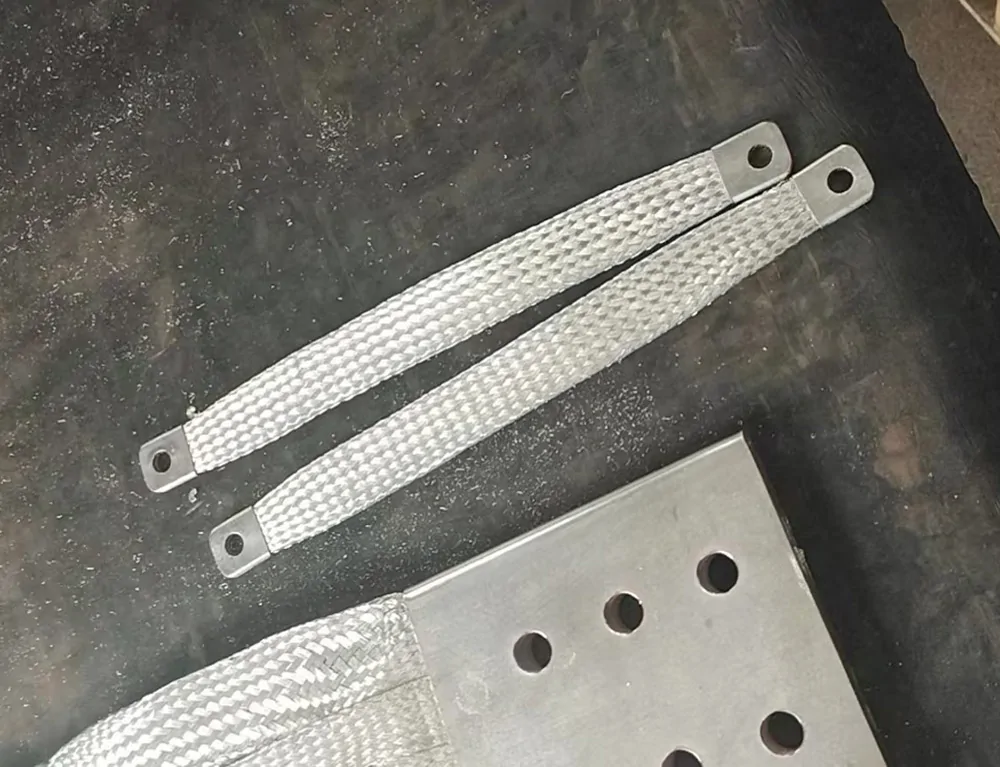
What information is needed for a flexible copper connector RFQ?
Send a dimensioned drawing or a clearly marked sample description. Identify the connector construction, overall length and width, flexible section dimensions, terminal geometry, hole diameter and spacing, contact area, surface treatment, quantity and application. Add the operating current, temperature environment, movement or vibration requirement and any inspection method defined by the buyer's engineering specification.
Flexible connector RFQ checklist
| Field | Information to send | Review purpose |
|---|---|---|
| Construction | Braided, laminated or another drawing-defined structure | Defines the flexible element and manufacturing route. |
| Overall dimensions | Length, width, total thickness and critical tolerances | Supports installation and clearance review. |
| Flexible section | Length, width, thickness or layer / braid information | Provides context for movement and assembly requirements. |
| Terminals / holes | Contact dimensions, hole diameter, spacing, slot and edge distances | Supports bolted connection and mating-part review. |
| Material / surface | Copper designation, contact finish or coating requirement | Clarifies material and contact-surface scope. |
| Application | Equipment, operating current, environment, movement and installation | Provides engineering context without replacing buyer validation. |
| Inspection | Dimensions, resistance or other buyer-defined acceptance checks | Clarifies what must be measured and documented. |
| Quantity / packing | Prototype and production quantities, protection, labels and export case | Supports quotation, handling and delivery review. |
Choose the construction type
Flexible connectors may use braided copper, stacked or laminated copper foils, or another drawing-defined construction. State the required type and provide the source specification when one exists. Do not select a construction only from appearance; flexibility, movement, assembly, current and temperature requirements should be validated by the buyer's electrical and mechanical engineering team.
Prepare a dimensioned drawing
The drawing should show overall length, width and thickness; the length of the flexible section; terminal dimensions; hole diameter and center spacing; slot geometry; edge distances; bend or offset; and critical tolerances. Mark the installation direction and mating surfaces. A 3D file may help communication, but a controlled 2D drawing should define inspection dimensions.
Define terminal and contact areas
Identify the bolted or welded contact region, hole or slot pattern, flatness requirement and surface condition. State whether the terminals are part of the same copper assembly or a separate component. If a coating or plating is required, define the material, coverage area, thickness requirement and governing specification rather than writing only "plated."
Provide electrical and environmental requirements
State operating current, duty pattern, ambient and equipment temperature, ventilation, installation orientation and any applicable insulation clearance. These values allow requirement review but do not by themselves establish connector suitability. Final conductor area, temperature rise and installation safety must be confirmed by the buyer's qualified engineering process and applicable standards.
Describe movement and mechanical loading
Explain whether the connector accommodates assembly tolerance, vibration, repeated movement or a fixed offset. Provide movement direction, range, frequency and expected service conditions when relevant. If tensile, bend or vibration testing is required, identify the test method, fixture and acceptance criteria.
Inspection and documentation
List critical dimensions and the required sampling or report format. Electrical resistance, material certificates, coating records or mechanical tests should reference a method and acceptance limit supplied by the buyer. Confirm document availability before order and separate prototype validation from routine production inspection.
Prototype, quantity and packing
Separate prototype quantity from expected production quantity. State whether the prototype is for dimensional fit, electrical validation or both. Packing should protect flat contact areas, coatings and flexible sections from deformation, moisture and abrasion. Include labels, lot identification and export-case requirements.
Flexible copper connector RFQ example
Product: Laminated flexible copper connector
Drawing: Controlled 2D drawing attached
Overall size: State length, width and thickness
Terminals: State hole pattern and contact area
Material: State copper designation and standard
Surface: State contact finish specification
Application: Electrical equipment connection
Requirements: State current, environment and movement
Quantity: Separate prototype and production demand
Inspection: State dimensions and test acceptance criteria
Frequently asked questions
Is a drawing required for a flexible copper connector quote?
A dimensioned drawing is strongly recommended because overall size, flexible section, terminals, holes, offsets and tolerances are product-specific. A sample description can support discussion but should not replace controlled dimensions.
Can connector current capacity be selected from dimensions alone?
No. Current, temperature rise, installation, duty, ventilation, conductor construction and applicable standards must be considered. Final suitability should be validated by the buyer's qualified engineering process.
What should be inspected on a custom connector?
Define critical dimensions, contact surfaces, hole geometry, material or coating records, and any buyer-required electrical or mechanical test with a stated method and acceptance limit.
Send the complete specification for review
Include the grade, dimensions, tolerance, condition, quantity, application, destination and packing or document requirements.
Send RFQ FormView Flexible Copper ConnectorReview Grade References